
Rashi: The Blueprint of Elemental Energy and Psychological Archetypes
We’ve learnt that your birth chart is a dynamic stage where your Planets (Grahas) — your psychological drives — act out lessons in specific Houses (Bhavas) — your life arenas.
But how do these actors perform? With what fundamental energy, style, and temperament?
This answer lies in the profound concept called Rashi (Zodiac Sign).
If you’ve ever read your sun sign or moon sign and felt it only described one piece of your complex personality, it’s because the Rashi is much more special than a simple label. A Rashi is a 30-degree energetic division of the sky that behaves as a specific Field of Energy —a unique environment or archetype that profoundly influences any planet placed within it.
1. Introduction: Beyond the Sun Sign
To comprehend your chart, you must distinguish between the actor and the environment:
- Graha (Planet): The Actor (The Who/ The Drive). The planet represents the psychological energy that initiates the action (e.g., the Moon = the need for emotional security).
- Rashi (Sign): The Stage/Costume (The How/The Flavour). The sign dictates the style and flavour of that action (e.g., if the Moon is in a Fire sign, the security is sought through action and confidence).
- Bhava (House): The Area of Life (The Where / The Experience) (e.g., the Moon in Aries in the 1st house indicates that your identity is defined by powerful emotional independence, driving you to act on every impulse. Self-worth is tied to courage, initiative, and being a pioneer.)
Understanding the Rashi is the key to unlocking the fundamental psychological motivation and the elemental nature of every placement in your chart. This guide will show you how the Rashi placement of your Moon, Ascendant, and Sun reveals the core psychological tendency and the specific flavour of your life force (Prana).
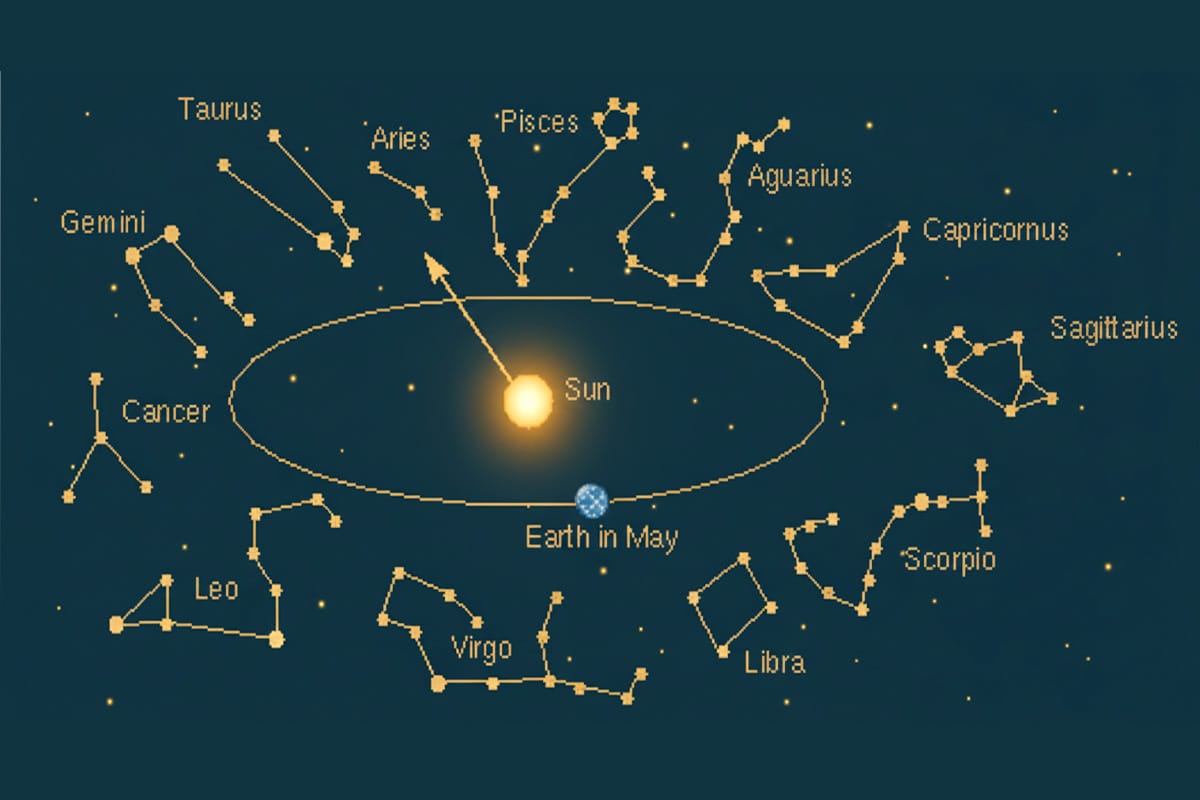
The 12 Constellations of the Zodiac
2. Significance of Rashi: Element and Quality
The twelve Rashis are not randomly assigned; they are organised according to precise cosmic principles that reveal their essence. Understanding these principles — the Four Elements (Tattvas) and the Three Modalities (Swabhavas) — is the key to discerning the fundamental temperament and behavioural patterns of any sign.
The Four Elements (Tattvas): Psychological Motivation
The twelve signs are classified into four elements — Fire (Agni), Earth (Prithvi), Air (Vayu), and Water (Jala). These elements reveal the fundamental psychological motivation and temperament of the energy field. Every planet placed in a sign takes on that sign’s elemental disposition and innate nature.
| Element | Signs | Core Psychological Drive | Theme (Purushartha) |
|---|---|---|---|
| Fire (Agni) | Aries, Leo, Saggitarius | Spirit, Action, Impulse, Confidence. Motivation comes from enthusiasm and identity. | Dharma/Purusha (Purpose/Spirit) |
| Earth (Prithvi) | Taurus, Virgo, Capricorn | Structure, Resource, Stability, Practicality. Motivation comes from tangible security and form. | Artha/Prakriti (Security/Matter) |
| Air (Vayu) | Gemini, Libra, Aquarius | Intellect, Connection, Movement, Socialization. Motivation comes from ideas, communication, and relationship. | Kama/Sattva (Desire/Mind) |
| Water (Jala) | Cancer, Scorpio, Pisces | Emotion, Intuition, Healing, Containment. Motivation comes from deep feeling and psychic connection. | Moksha/Tamas (Liberation/Depth) |
For example, a planet in an Earth sign will prioritise security and structure over emotional needs or abstract ideas.
The Three Modalities (Swabhavas)
These modalities define the way in which the Rashi’s energy expresses itself in time — how it initiates, sustains, or adapts to change. These qualities are often referred to as the “Swabhavas” (Movable/Cardinal, etc.).
- Cardinal/Movable (Chara): This energy is about Initiative, starting things, and pushing for change (Aries, Cancer, Libra, Capricorn). It brings vitality but can lack stability due to its fleeting nature.
- Fixed (Sthira): This energy is about Stamina, stability, and deep endurance. It provides the anchor but can lead to rigidity and resistance to necessary change (Taurus, Leo, Scorpio, Aquarius).
- Dual/Mutable(Dwiswabhava/Ubhaya): This energy is about Flexibility, adaptation, and analysis. It is highly intellectual and versatile but can struggle with indecision and sustained, single-pointed focus (Gemini, Virgo, Sagittarius, Pisces).
The combination of Element and Modality gives each Rashi its unique character. For instance, Aries is a Fire (Action) and Cardinal (Initiating) Rashi, which exhibits its core nature as an impulse to initiate things with assertive energy.
3. Rashi Psychology and Inner Mastery
The true mastery of Rashi lies in linking its elemental nature to your inner healing and personal psychology. The sign is the blueprint that informs how to approach challenges and fulfil innate needs, making it a critical part of your overall Vedadhaara practice.
Understanding Emotional Needs (Moon Rashi)
The sign of your Moon is the most potent psychological placement. It reveals your Inner Narrative, your deep-seated emotional core, and what is fundamentally required for you to feel safe, secure, and nurtured.
- Moon in a Fire Sign (Aries, Leo, Sagittarius): The need for security is tied to action, courage, self-assertion, and feeling vital/significant. Emotional safety is found through outward expression of passion, spontaneous initiative, and receiving recognition.
- Moon in an Earth Sign (Taurus, Virgo, Capricorn): The need for security is tied to tangible structure, material resources, and competence. Emotional safety is found in work, discipline, and stable foundations.
- Moon in an Air Sign (Gemini, Libra, Aquarius): The need for security is tied to intellectual stimulation, communication, and balanced social exchange. Emotional safety is found through understanding and dialogue.
- Moon in a Water Sign (Cancer, Scorpio, Pisces): The need for emotional security is tied to depth, containment, and intuition. Emotional safety is found through processing deep feelings and tending to Inner life.
By knowing the Moon’s Rashi, you stop fighting your innate needs and start honouring the unique mechanism required for your emotional core to thrive.
Role of Rashis in Inner Healing
The element and quality of an afflicted sign don’t just describe a problem; they reveal the precise method of healing and remedial action required.
| Rashi Element | Psychological Challenge | Healing Method Required |
|---|---|---|
| Earth | Stubbornness, attachment to material security, rigidity. | Grounding and Structure. Requires tangible discipline, realistic planning, and structural remedies (e.g., diet, Seva). |
| Water | Emotional overwhelm, co-dependency, lack of boundaries. | Emotional Release and Surrender. Requires non-linear healing, therapy, and acceptance of the flow (Moksha). |
| Fire | Ego conflict, impulsive action, burnout, anger. | Direction and Rechanneling. Requires assertive movement, physical activity, and focused meditation (Dharma). |
| Air | Indecision, anxiety, over-analysis, superficiality. | Clarity and Connection. Requires communication, detachment, and intellectual perspective shifts (e.g., focused Pranayama). |
4. The Architecture of the Rashi Chakra
To utilise the psychological archetypes associated with your Rashis, you must understand the architecture of the zodiac itself. The Rashi Chakra is the stationary template upon which the entire drama of your life unfolds.
The Rashi Chakra: The Stationary Backdrop
The Rashi Chakra is the 360-degree zodiac wheel — the eternal backdrop of the cosmos. It is the fixed reference frame used by astrologers.
- Fixed Order: The signs always proceed in the same order (Aries → Taurus → Gemini, and so on).
- Sign Rulership: Each Rashi has a natural ruling planet (e.g., Mars rules Aries, Venus rules Taurus and so on). This planetary lordship defines the source of the Rashi’s energy.
- Body Parts: Each sign is intrinsically linked to specific parts of the body, which ties the Rashi’s energy directly to the Physical Sheath (Annamaya Kosha). For example, Aries rules the head, and Pisces rules the feet.
Similar to the above significations, every rashi has a varied set of meanings that help us to pinpoint further details.
The Rashi Chart
Your Rashi Chart is a static snapshot of the Rashi Chakra at the precise moment and location of your birth. It is a map showing which Rashi was rising on the Eastern horizon (your Ascendant/Lagna) and where all the planets were positioned within the 12 signs.
Chart Representation: The South Indian Style
On the Vedadhaara path, we will often utilise the South Indian Chart Style for its clarity and ease of practical application.
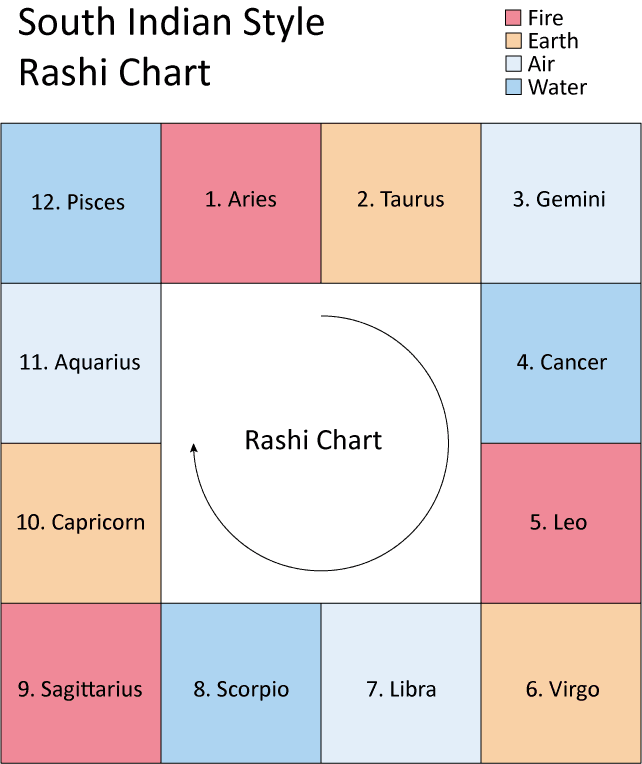
- Fixed-Sign Layout: Unlike other chart styles, the South Indian format utilises a fixed sign grid where the signs always remain in the same physical location/box.
- Aries(1) is always in the same box.
- Taurus (2) is always in the next box, and so on.
- Clarity for Houses(Bhavas): The Houses are determined by your Ascendant (Lagna). The box with your Ascendant (Lagna) is considered the 1st house. Then, we move clockwise, counting 2nd, 3rd, and so on, till we reach the 12th house. E.g., if your Ascendant falls in Leo, Leo becomes your 1st house. Moving clockwise, Virgo becomes your 2nd house, Libra becomes your 3rd house, Scorpio becomes your 4th house, and so on till Cancer, which becomes your 12th house.
This fixed-sign layout provides a clear and powerful view of the planetary positions relative to the Rashi archetypes, making it a highly effective tool for psychological analysis.
Significations: The Complete Context
The Rashi provides the full context for interpretation, linking abstract energy to concrete reality.
- The element and quality give the psychological flavour.
- The body part shows the area of physical vulnerability.
- The ruler shows the source of the energy that governs that part of the psyche.
The primary details associated with each Rashi are given below:
| Rashi | English equivalent Sign | Symbol | Rashi Lord | Equivalent Sign Ruler | Extent in degrees |
|---|---|---|---|---|---|
| 1. Mesha | Aries | ♈ | Mangala | Mars | 0-30 |
| 2. Vrisha | Taurus | ♉ | Shukra | Venus | 30-60 |
| 3. Mithuna | Gemini | ♊ | Budha | Mercury | 60-90 |
| 4. Karka | Cancer | ♋ | Chandra | Moon | 90-120 |
| 5. Simha | Leo | ♌ | Surya | Sun | 120-150 |
| 6. Kanya | Virgo | ♍ | Budha | Mercury | 150-180 |
| 7. Tula | Libra | ♎ | Shukra | Venus | 180-210 |
| 8. Vrischika | Scorpio | ♏ | Mangala | Mars | 210-240 |
| 9. Dhanu | Sagittarius | ♐ | Guru | Jupiter | 240-270 |
| 10. Makara | Capricorn | ♑ | Shani | Saturn | 270-300 |
| 11. Kumbha | Aquarius | ♒ | Shani | Saturn | 300-330 |
| 12. Meena | Pisces | ♓ | Guru | Jupiter | 330-360 |
By accurately placing the Rashis in their fixed order, you create the precise map required for all deeper Astrological and Psychological work. Are these the only details necessary for understanding the Rashi? I am afraid not. Each Rashi has a vast majority of characteristic features and significations associated with it. Let’s go through some additional details that may be helpful in our upcoming discussions.
| Sign | Element | Body Part | Colour | Dosha | Guna | Modality |
|---|---|---|---|---|---|---|
| 1. Mesha | Fire | Head | Bood Red | Pitta | Tamas | Movable (Chara) |
| 2. Vrisha | Earth | Face, Throat | White | Vata | Rajas | Fixed (Sthira) |
| 3. Mithuna | Air | Shoulders, Arms | Green | Mixed | Rajas | Dual (Dwiswabhava) |
| 4. Karka | Water | Chest | Pale-Red | Kapha | Sattva | Movable (Chara) |
| 5. Simha | Fire | Upper Abdomen | Light White | Pitta | Sattva | Fixed (Sthira) |
| 6. Kanya | Earth | Mid Abdomen, Hands | Variegated | Vata | Rajas | Dual (Dwiswabhava) |
| 7. Tula | Air | Lower Abdomen | Black | Mixed | Rajas | Movable (Chara) |
| 8. Vrischika | Water | Genitals, Anus | Reddish-Brown | Kapha | Tamas | Fixed (Sthira) |
| 9. Dhanu | Fire | Hips, Thighs | Tawny | Pitta | Sattva | Dual (Dwiswabhava) |
| 10. Makara | Earth | Knees | Variegated | Vata | Tamas | Movable (Chara) |
| 11. Kumbha | Air | Calves | Deep Brown | Mixed | Tamas | Fixed (Sthira) |
| 12. Meena | Water | Feet | White | Kapha | Sattva | Dual (Dwiswabhava) |
The brilliance of the Rashi Chakra doesn’t end here; it holds a deeper, more subtle layer of wisdom. Each Rashi (sign) is further comprised of two and one-quarter Nakshatras (Lunar Mansions), thereby completing a cycle of 27 Nakshatras across the zodiac. These lunar mansions act as the micro-lenses of destiny, refining the Rashi’s energy precisely. While the Rashi tells us what the energy is, the Nakshatras define the exact quality and texture of that experience. We’ll delve into the profound secrets of these 27 Nakshatras in detail in our later articles.
Conclusion: The Power of Collaboration
We’ve completed the essential architecture of your cosmic blueprint: the Grahas (Actors), the Bhavas (Stages), and now the Rashis (Archetypes). By studying the specific flavour and elemental nature of the signs in your chart, you gain the deepest insight into your innate psychological mechanics.
Rashi reveals the essential psychological tendency and energetic environment of your personality, providing the crucial context for all the actions of your planets. Whether it’s the need for tangible achievement in an Earth sign or the drive for intuitive connection in a Water sign, these archetypes define how you seek fulfilment and how you naturally react under stress.
This knowledge transcends a generic self-view and empowers you to choose the highest expression of every archetype within you. You stop fighting your basic elemental nature and start consciously collaborating with the wisdom embedded in your design.
The goal of Rashi study is not to be defined by a label, but to gain the power to channel its energy. By understanding the archetypes that colour your chart, you make the shift from passive fate to conscious collaboration with your destiny, directing your energies toward your highest purpose (Dharma).
Your Next Steps to Integration
With the complete framework for reading the entire psychological sentence of your chart: Actors, Stages, and Archetypes in your quiver, it’s time to apply this in practice:
- Synthesis and Practice: Revisit Astropsychology: Unveiling the Outer Mask to practice synthesising the Graha + Rashi + Bhava equation. This is the final step in synthesising your chart map — understanding who is acting in what style in which area of your life.
- Apply the Remedial Method: Dive into the Toolkit of Transformation and use the elemental nature of an afflicted Rashi (Fire, Earth, Air, or Water) to select the precise healing modality and conscious action required for self-correction.
Keep exploring. We’ll meet you on the path.


